Longmont's new tiny home village for unhoused veterans is example of what a city can do when they waive excess red tape

(Housing First model)
(ER, police, courts)
Sources: PMC/NIH (Housing First costs); National Alliance to End Homelessness (homelessness costs); savings = cost difference × 26 homes.
A tiny home village for unhoused veterans in Boulder County welcomed its first four residents this summer. The project serves as an example of how cities can work with developers to create housing solutions and turn neighbors into allies — if they're willing to get out of the way.
On a 2.5-acre plot west of downtown Longmont near the city airport, Jennifer Seybold, Executive Director of Veterans Community Project (VCP), showcased the partly finished village. "You're looking at the village space, the community center in the middle of the village here, is where all of our services, on-site case management will happen," she explained.
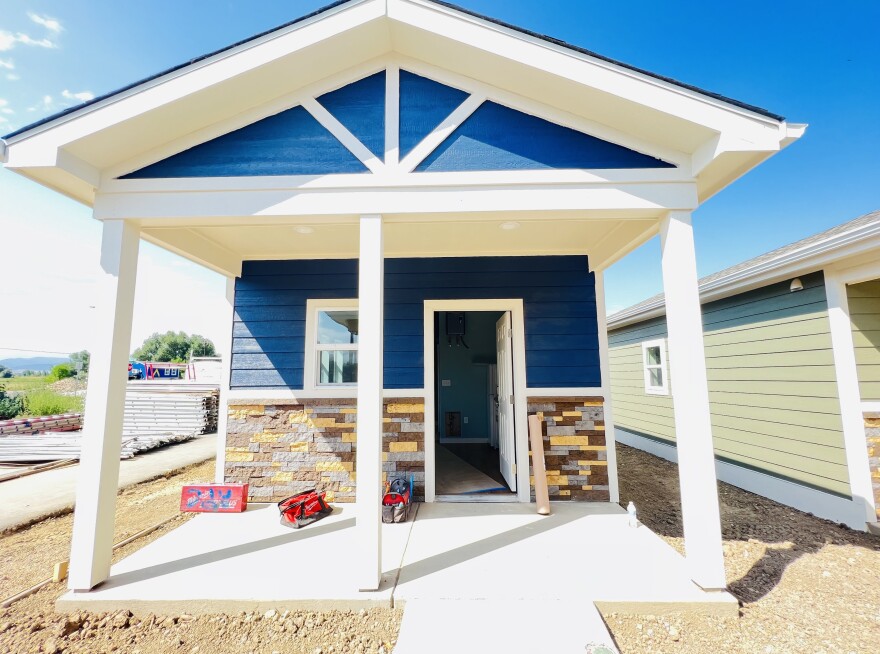
The village will feature 26 tiny homes designed with stone siding and large covered porches, providing transitional housing for unhoused veterans. The rooms are light-filled with space for furniture and a full-size bed. "So it's got everything your standard home has. It's just smaller," Seybold said.
The project implements a "Housing First" strategy — addressing homelessness by providing stable housing as the foundation for addressing other needs.

The Math Cities Ignore: Cost Per Person, Per Year
Sources: PMC/National Institutes of Health (Housing First costs); National Homeless Voice/Seminole County study (law enforcement costs); National Alliance to End Homelessness (combined costs)
Sources: NLIHC Housing First research (ER visits); Urban Institute Denver SIB study (arrests); VCP Longmont (85% rate)
Homelessness Reduction: What's Working Elsewhere
Houston uses a Housing First model at scale. Boulder County's 2025 Point-in-Time Count found 140 unsheltered individuals, down from 243 in 2023. Sources: CBS News/Coalition for the Homeless (Houston); City of Boulder 2025 Point-in-Time Count; City of Longmont coordinated entry data.
Boulder City Council member Nicole Speer highlighted the county's progress: "Since 2017 when we started this, we've housed about 1,600 individuals, which is a pretty substantial amount, and I think we can also see that it's not really enough."
Longmont real estate developer Kevin Mulshine initially resisted the concept. "You can't sell houses next to a homeless encampment. And that's understandable," he stated. But after visiting five different Housing First developments, including VCP's flagship Kansas City facility, his perspective shifted. "What really did a 180 for me was it was such a vibrant campus and so volunteer-centric." He became convinced that a housing community could function as a neighborhood amenity rather than a liability.
Mulshine donated 2.4 acres to VCP. Critically, Longmont expedited his development approvals. During one meeting with the mayor and VCP founder Jason Kander, the latter pushed back against extended bureaucratic review. The mayor responded by streamlining the process, ultimately saving the project approximately two years without costing the city additional resources.
The Red Tape Problem: How Long to Get Housing Approved
Longmont VCP: Planning Commission approval May 2019, City Council approval July 2019 (Longmont Leader). Denver: 233-day average for major projects, 2023 (SDB Denver). National cities: median permitting for large multi-family projects, White House Council of Economic Advisers, 2024.
Why Cutting Red Tape Saves Lives, Not Just Time
Research shows that the longer someone stays homeless, the harder it is to get them housed permanently. A VA study found that Housing First programs cut time to placement from 223 days to 35 days — and housing retention jumped from 86% to 98%.
Families housed within 30 days had 79% housing stability at six months. Those who weren't housed? Just 27%.
Every month a housing project sits in a permit queue is another month people stay on the streets — where they cost taxpayers more, cycle through emergency rooms, and become harder to reach. In Washington state, permit delays alone add an estimated $31,000 to the cost of each new home.
Sources: VA Research Brief, 2023 (placement speed & retention); NLIHC Housing First Evidence (30-day outcomes); WA State housing analysis (permit cost impact)
Mulshine emphasized the mutual benefits: "For the most part, the entire experience has been a win-win. He sold the VCP community as an amenity to the builders, and the people who moved in say they like to be able to walk over to the campus and work with the veterans."
VCP's model, while successful, has significant limitations. The organization conducts randomized drug testing, accepting only veterans with documented sobriety. The program also excludes veterans with recent violent crime histories and those with disabilities requiring ADA-compliant facilities. Seybold outlined the core criteria: "The biggest thing I will say is its just a willingness to engage in working on yourself. And so if you're not willing to engage in that, it's probably not going to be the place for you."
For those ineligible, Seybold noted VCP partners with other community organizations: "We don't reinvent services. We partner with people who do those things well."
Seybold credited the broader community: "I have to say it is a community issue to solve, and frankly, I am incredibly proud of what the City of Longmont has done, but truthfully, I think it's just been a community-wide effort."
Despite progress toward functionally zero veteran homelessness in Boulder County, the county faces growing housing instability among other populations. Speer noted that 300 BVSD students experienced homelessness last year, with nearly 800 countywide.
"We also really have to be focused on prevention because without focusing on prevention, we can keep putting more and more and more money into enforcing our camping ban... but it's like trying to put a Band-Aid on a dam that's about to break." — Nicole Speer, Boulder City Council member
This story was originally published October 17, 2023 on KGNU Community Radio.